What Does the Code Wt Mean as a Water Meter Reading

The first step in irresolute the way you apply water in the future is by understanding how much water you use today. The all-time place to observe this information is on your monthly water bill. Pull out your water beak and follow the steps below to learn more virtually it and your ain water use.
On This Page:
- How much do you use?
- What is your usage trend?
- How does your use compare to that of your neighbor?
- How are you beingness charged?
- What are my charges going towards?
- More than Data
How much practice y'all use?

Unlike utilities utilize dissimilar units for measuring h2o use. The almost common units are centum cubic feet (CCF) and the gallon. A CCF also called an HCF (hundred cubic feet), represents one hundred cubic feet of water. The outset "C" comes from the Roman word for hundred, "centum." This is the well-nigh common unit used by both water and natural gas utilities. Simply y'all may be more familiar with the other unit of measurement, the gallon. One CCF is equal to 748 gallons.
What does your usage mean? The boilerplate American uses around 88 gallons per day per person in the household. That means a family unit of four would use around 10,500 gallons in a 30-day flow. But usage varies a great deal beyond the country, by and large because of differences in atmospheric condition patterns. For example, water use tends to be college in drier areas of the country that rely more on irrigation for outdoor watering than in wetter parts of the country that can rely on more rainfall.
Based on information from Water Research Foundation, "Residential End Uses of Water, Version 2." 2016; and The US Geological Survey, "Estimated Water Use in the United States." 2010.
What is your usage trend?
Does your bill explain your household's usage tendency? Some utilities provide graphs like the ones below that evidence how your water utilise has varied over the course of the yr and previous years. This can be a helpful way of seeing when your own water use reaches its highest levels.

While using water efficiently is important throughout the year, sometimes the timing of water employ can make a big divergence for community h2o supplies—and your water bill. WaterSense has tips to help you reduce your water employ when it's hot outside.
Water utilities operate with this higher, summertime use in listen considering they must be able to provide for all the water a community needs over an extended period. Some systems may exist forced to restrict outdoor watering during the peak to ensure that water is bachelor for more important community needs.
How does your employ compare to that of your neighbour?
Some utilities provide information on how your household compares to that of your neighbors. This can help you lot see how your usages stacks up versus other users in your same climate area and can be a helpful way of gauging your "WaterSense." Some utilities utilise bills that compare your use to a random group of your neighbors while some utilities apply a "tiered system" to differentiate users such as in the instance below.

How are yous being charged?
Water utilities demand to charge customers to build and maintain infrastructure—the water storage tanks, treatment plants, and underground pipes that deliver water to homes and businesses. The acquirement is also used to pay the workers who provide y'all with water service day or night. In that location are a wide diversity of rate structures that are used to nib customers, some of which are described below.
Rate Types
Apartment Fee is a charge per unit structure where all customers are charged the aforementioned fee, regardless of the corporeality of h2o used. Flat fees are the simplest type of rate construction and are rarely used today. They generally don't provide revenue sufficient to operate the utility and are not adept at promoting water efficiency.

Uniform Charge per unit is a structure that has a abiding per unit price for all metered units of water consumed on a year-round footing. It differs from a flat fee in that it requires metered service. Some utilities charge varying user groups different rates such equally charging residential households one rate and industrial users a different charge per unit. Constant block rates provide some stability for utilities and encourage conservation because the consumer pecker varies with water usage.

Increasing Block Rates is a charge per unit construction in which the unit toll of each succeeding block of usage is charged at a higher unit rate than the previous block(s). Increasing block rates are designed to promote conservation and are most ofttimes found in urban areas and areas with express water supplies. The graphic to the right is an instance of an increasing block rate structure.

Failing Block Rates are the opposite of increasing block rates where the unit price of each succeeding cake of usage is charged at a lower unit charge per unit than the previous block(s). This rate structures are pop in rural areas that service large farming populations or areas with big users such as heavy manufacture and where water is plentiful.
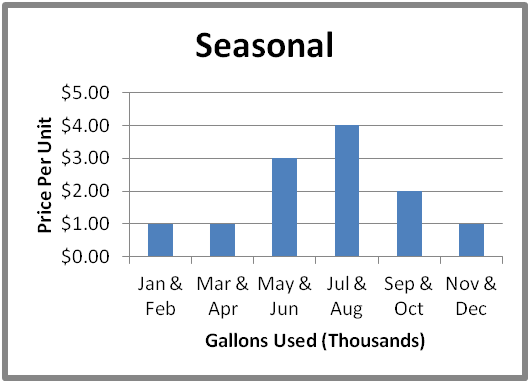
Seasonal Rates are rates that cover a specific time menses. They are established to encourage conservation during summit use periods. Examples of seasonal rates may take lower rates for the winter season and higher rates for the summer season due to increased water demand associated with lawn watering and exterior activities.

Drought Rates are similar to seasonal rates only instead of applying college rates during an entire time flow, they adjust rates based on the local area'due south drought level. College levels of drought result in higher prices for water in order to encourage conservation.

Water Budget Based Rates is a rate construction where households are given a "water budget" based on the anticipated needs of that household either by the number of people living in the house and/or property size. Users are charged a certain rate for use within their upkeep and a higher rate for use that exceeds their upkeep. The goal is to encourage efficient water use of every individual client.
What are my charges going towards?
Many utilities use a combination of a fixed fee (base) and a variable fee (book) for their h2o charge per unit structure. Fixed charges by and large include the cost the customer pays as a base of operations charge to assistance encompass costs for maintaining existing infrastructure and repaying loans and bonds used to build that infrastructure. Variable charges are the price the customer pays per volume of water used, which reflect the costs of providing water, such as costs for chemic treatment to provide safe water and energy to move and deliver water.
Most utilities will provide you with a breakdown of charges in your "billing detail" or "summary of charges" section. Note that some utilities measure both water entering the firm and waste leaving to the sewer, but many utilities take only one meter on location and will charge both volumes based on water inbound the house. This is however some other reason to reduce your own water use. If y'all're curious about what diverse surcharges and other charges on your utility bill hateful, you tin ordinarily discover that information either on the back or appendix of the bill or on your local water utility's website. 2 examples are provided below.

Uniform Rate Case - in the offset example, roughly half of the $147.62 being charged is directly related to water use. Most utilities charge a set apartment fee (the "Water Base Facility Charge" in the example) that helps to pay for the base costs of providing water including the electricity needed to transport and clean the water, the personnel and others costs of daily maintenance of the delivery system, and other fixed operating costs.
This utility uses a uniform rate structure that charges the user $0.00295 per gallon (or roughly iii cents for every x gallons) used during the billing period. The beak also shows a similar facility accuse for sewer and a "charge per unit case expense surcharge" to aid pay for the utility's rate setting process. The "regulatory assessment fee" helps the utility pay for costs associated with maintaining regulatory compliance with clean water statutes. Finally, some utilities charge fees similar to the "Deferred Capital Expense Surcharge" which puts money into a fund to help pay for long term investments in improvements to infrastructure such as new pipes, treatment facilities or reservoirs.

Increasing Block Charge per unit Example - this second bill is an case of an efficient user with an increasing cake rate structure. You lot can encounter that the utility has even labeled the various blocks with its corresponding h2o utilise efficiency level. The higher up user falls into the "Efficient" grouping and and then avoids the much college per unit costs of the side by side three tiers. Some utilities will forgive various surcharges for its most efficient users because their below average h2o apply places less burden on the organisation and reduces demand for new sources of water and pipes to transport this water.
More Information
Utilities will frequently apply the back of the bill as a "bulletin surface area." This expanse will sometimes have data on rebate programs, water efficient products, or other tips on water conservation.
If you're looking for more information on how your bill functions, yous can visit the following sites:
- For interactive examples of bills visit Understanding your Water Bill pages from the East Bay Municipal Bay Utility Commune (CA) and Cleveland (OH) Water.
- To learn more about what services are being paid for from water bills, visit the Financing Sustainable H2o page for concerned citizens.
- For an instance of an interactive, comparative utility nib, visit WaterSmart Software.
What Does the Code Wt Mean as a Water Meter Reading
Source: https://www.epa.gov/watersense/understanding-your-water-bill
0 Response to "What Does the Code Wt Mean as a Water Meter Reading"
Post a Comment