How to Make the Blacks Printer Richer on Fine Art Matt Paper
How to Choose a Paper for Press Your Photos
I love to print my own photos but when I started printing I was overwhelmed by the incredible number of papers available. There are hundreds of options on the market place and I was paralyzed past having too many choices. So I took the easy way out. In that location were a few sheets of luster newspaper included with my first printer, and then I tried them, liked the result, and I just stuck with that paper for many years.
Every bit I got more than into fine fine art printing, I started branching out into other paper types. While there are many unlike papers, they mostly vary on only a few different dimensions or characteristics. Once you are aware of these, it becomes much easier to understand the choices and to pick a paper that volition piece of work for you lot.
Glossy vs Matt
Glossy papers are by and large more vibrant and have richer and darker blacks. Sometimes this is referred to every bit the paper having a higher black density or Dmax. The drawback of sleeky papers is that they tin can prove reflections, glare, and fingerprints which backbite from the viewing experience.
In contrast, matt papers await good from whatever angle but ofttimes have more muted colors and typically worse blackness levels. Just y'all don't e'er need the about saturated colors and matt papers tin have a charm of their ain. Also our eyes suit to the environment and then that even though the black on a matt paper is measurably lighter than a glossy paper, perceptually it can seem every bit night or even darker. Matt papers are a favorite of portrait photographers too every bit mural photographers who shoot more than intimate and softer scenes.
 I of the advantages of matt paper is the lack of reflections if lighting is less than optimal. Shown is Epson Hot Printing Bright (a matt paper) on the left vs Moab Juniper Baryta (a sleeky paper) on the right.
Smoothen vs Textured Surface
Some papers are shine and have a completely flat surface while others will accept a noticeable surface texture. The texture impacts the appearance of the epitome and for glossy papers can have a big result on how devious light reflects off the face of the print.
Papers have different types of textures. They tin can vary in size from a very fine stipple to larger patterns that you could even experience with your fingers. The texture might have a grain or management which means you'll get slightly unlike results depending on the newspaper orientation when loaded. Finally the texture could be very regular, as if imparted by a auto postage, or information technology could be more irregular as if made by an organic procedure.
 The surface texture of Hahnemuhle Torchon paper. The print is in a black matt and I photographed information technology with sunlight coming in from the correct side to emphasize the texture. The impress is roughly 12x18" in size.
Warm vs Absurd Paper White
Is there a tint to the paper? Some papers will appear a fleck warm with xanthous tones whereas others will appear cool with blue tones.
 The deviation in the paper white can be substantial. On the left is Hahnemuhle Photo Rag Baryta and the right is Hahnemuhle Baryta FB. White balance is gear up to the foam core behind both prints (the cream core is probably on the cool side making Photo Rag Baryta seem a bit warmer than actual).
Paper Brightness & use of OBAs
How bright is the paper white? A brighter paper will appear more than vibrant and brand the image standout a flake more than from the surroundings. But in order to become a whiter and brighter newspaper, manufacturers will often add optical brightening agents (OBA). These are chemicals added to the paper, either in the surface blanket or the newspaper base, that provide a higher whiteness to the paper. In some cases OBAs will absorb UV light and fluoresce.
While a brighter paper would normally be a expert thing in that location are some drawbacks acquired by using OBAs. OBAs tin can make the newspaper blue, they too have a tendency to exist unstable and intermission down over time. This will crusade the newspaper to discolor and yellow. The full general thought is if you are concerned about print longevity, i should seek out a paper with trivial or no OBAs. However in that location are some exceptions, for case, Epson Hot Press Brilliant with OBAs generally scores also as it'south sister newspaper Hot Press Natural (no OBAs) on light fading tests.
It tin be hard to tell if a newspaper contains OBAs. Sometimes the name gives a clue every bit papers with "Bright" generally have whitening agents whereas a "natural" paper will non have these. You can as well look at the manufacturers description and meet if they make an explicit statement almost no OBAs. If there is no such statement, I would assume the paper does contain OBAs.
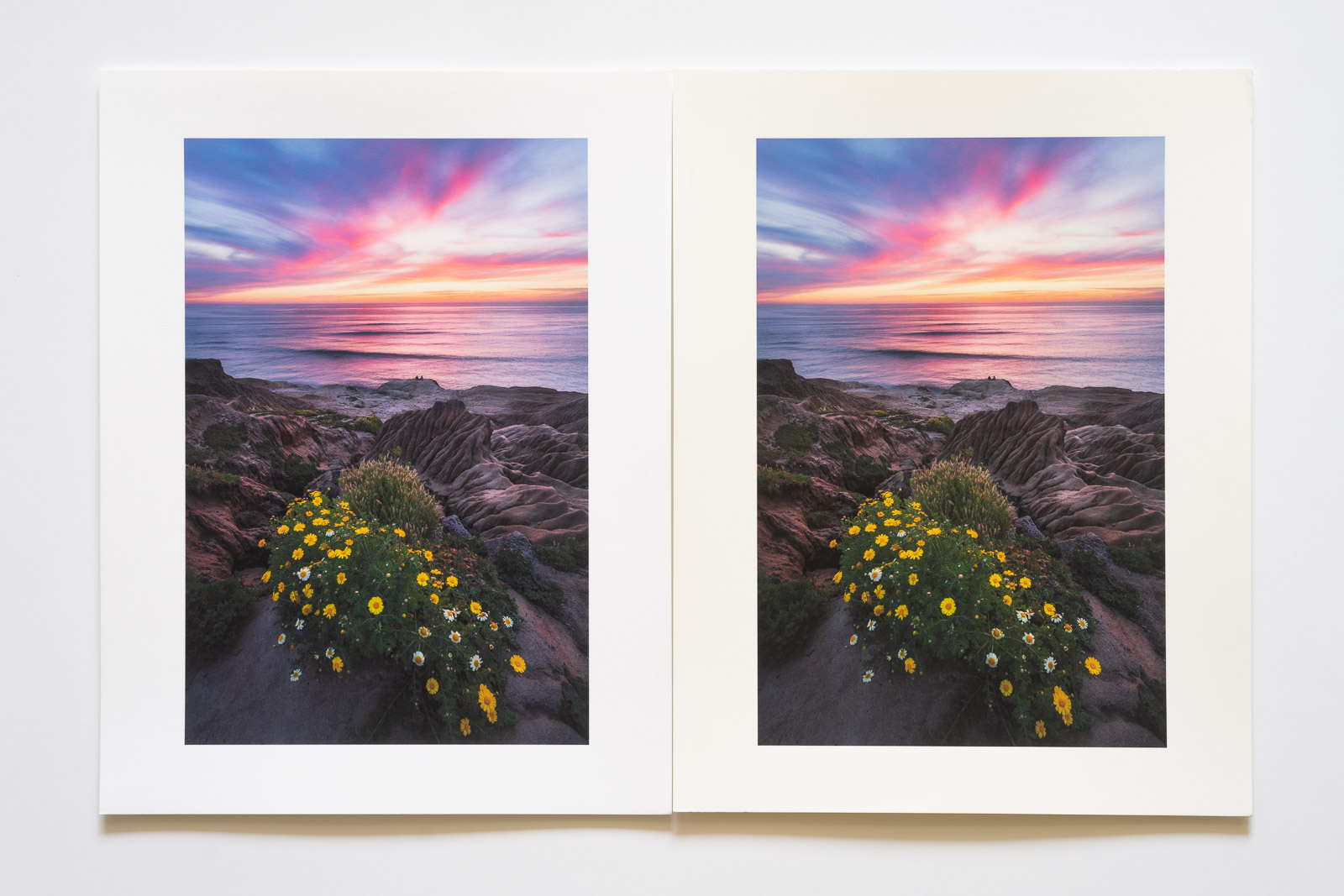 On the left is Epson Hot Press Vivid which has optical brightening agents (OBAs) vs Hot Printing Natural on the right. White balance gear up to the foam core behind both prints. Epson states that Hot Printing Bright has an ISO brightness of 96 vs 90 for Hot Press Natural.
Gamut
This is the range of colors that can exist printed on the newspaper. It depends both on the paper surface and the item printer and inkset that y'all employ. In full general you want as wide a gamut as possible equally because attempting to print out of gamut colors tin result in a ho-hum color on the impress, posterization, and loss of detail within patches of out-of-gamut colors.
 The solid cherry-red areas indicate out-of-gamut colors on the specific combination of paper and printer: (a) Epson Premium Glossy on an Epson P800 printer, (b) Moab Metallic Pearl also on a P800 printer, and (c) Moab Metallic Pearl on an Epson P20000 printer. All iii paper/printer combinations have problems reproducing the ruddy colors in the aloe flowers and to a bottom extent, the greens and yellows in the vegetation. The Moab paper is worse in this regard, merely changing the printer from the P800 to P20000 helps tremendously due to an improved inkset. Yous can view out-of-gamut colors in Lightroom by entering soft-proofing mode and clicking the top right triangle in the histogram.
Cotton wool Rag vs Alpha Cellulose
This is the base material used in the newspaper. Cotton rag refers to paper made from cotton fibers whereas alpha-cellulose is wood pulp. Cotton and alpha cellulose papers feel dissimilar to the bear upon although I personally don't have a preference for ane or the other. Both types of newspaper are sometimes referred to equally fiber based.
Some papers are resin-coated which means that the base (normally alpha cellulose) has been covered by two layers of polyethylene plastic. RC papers tend to be thinner, more than water proof, and scuff resistant but they are basically plastic and don't experience equally dainty.
Newspaper Curlicue and Treatment
Some papers prevarication completely flat and are very easy to work with. Other papers may take strong curl even when you lot purchase a box of precut sheets. This could cause issues when loading the newspaper and potentially cause headstrikes while press. Papers may likewise curl a bit or become wavy after laying down ink.
Fade Resistance and Longevity
How long can the print be displayed before fading and color shifts becomes noticeable? Longevity depends on many factors including the paper, the printer and inkset, and the display surround. Just mostly a paper that performs well with Epson printers, will perform well with Canon and HP printers.
Some papers tend to exhibit fading after short time periods. For case, in longevity tests a newspaper like Epson Exhibition Cobweb might exhibit noticeable fading in as piffling equally x years in average home weather condition wheras the aforementioned photo printed on Hahnemuhle Photo Rag might survive 60 years without fading (these results are from aardenburg-imaging.com with an Epson 3800 printer).
Cost
This is the price of the paper. Some of the fine art papers tin can go pretty expensive. For example, taking a quick look at the prices online, the price of a sheet of 17x22" newspaper could range anywhere from $2 to $12. Yes that'due south right $12 for a single sheet of paper. Better promise you don't brand whatsoever mistakes or need to reprint. Ordinarily cotton is more expensive than alpha cellulose which in turn is more expensive than resin-coated papers. Due to paper costs some people will proof on a cheaper paper before printing the final version.
Intended Use
When choosing a newspaper, I think it's important to keep in mind the intended use. For example,
- If I want to brand a print for a competition, I'll pick a paper with vibrant colors and deep blacks. I won't intendance about OBAs or whether the colors are going to fade in a few years.
- If the photograph is going to be framed behind glass, I may choose an RC paper because it will typically stay flatter than cobweb papers (i.eastward. cotton fiber rag or blastoff cellulose) and the feel of the newspaper doesn't matter.
- If the prints are going to exist shared as a loose portfolio, then I want a paper that is scuff resistant and doesn't take a delicate surface. I may want a thicker cotton rag newspaper as that feels nicer in the mitt.
- If I'm going to have the newspaper facemounted to acrylic, I will need to selection a paper with a smooth forepart surface. This unremarkably ways a resin coated paper.
Some papers I like
I use a variety of papers in my own printing and they all take different pros and cons. What's of import to you for a given picture will lead you to different papers, only here are a few that I like (in no particular order):
-
Epson Exhibition Fiber – a very brilliant sleeky/satin paper with amazing gamut, smashing for highly saturated ballsy shots. I utilise this for short-term exhibitions/competition prints. The downside is this newspaper is chock total of OBAs and has poor fade resistance.
-
Canson Platine – a luster cotton wool rag newspaper with good gamut and a squeamish texture. I really like the style it looks. Downside is paper curl and it's on the expensive side. I have a lot of problems feeding this paper in my epson P800.
-
Ilford Golden Cobweb Silk/Canson Baryta (original) – a baryta paper with amazing gamut and Dmax and very lilliputian surface texture (only a very fine stipple) on the paper. Little OBA content. The downside is this paper is discontinued.
-
Hahnemuhle Photograph Rag Baryta – I just started printing with this and I like it very much. The paper has no OBAs and has keen fade resistance. The main con of this paper is price, this is ane of the near expensive papers you can purchase.
-
Moab Juniper Baryta – A warm toned baryta paper with a nice surface texture. Information technology has a bit more muted colors than the Canson baryta (maybe almost the same as Canson platine) and is relatively inexpensive.
-
Epson Hot Press Bright – a shine and bright white paper matt paper with skillful blacks and color gamut. The paper has no texture/smooth surface. I like this for muted scenes and some B&W images.
-
Hahnemuhle Torchon – a heavily textured matt newspaper that lends itself to sure pictures.
-
Epson Premium Glossy – This is a cheap RC newspaper that is good for proofing. It has a smooth flat surface so it tin can exist face mounted (in which instance it looks stunning).
-
Moab Metallic Pearl – I don't have a lot of experience with different metallic papers but this 1 works well for me. Gives the image a "shimmery" experience that goes with certain pictures. Downside is a low white point, the paper is noticeably dimmer than other papers, although this is a characteristic of all metal papers.
How to get Started
Some things need to exist experienced and no matter how much you read most a paper, information technology's not the same as making a impress on information technology and being able to hold and view it in person. So expect some trial and fault when seeking out printing papers.
Some photographers recommend buying a sample pack to test out various dissimilar papers. Usually the pack volition run about $20 and have 2 sheets of 5-10 different papers from a manufacturer.
I've gone the sample pack route but I now prefer just buying a small box of 25 sheets of the paper I want to try. I find 2 sheets isn't anywhere almost plenty to get a practiced feel for the paper. Likewise sample packs are restricted to papers from i manufacturer and usually have a lot of papers that I'thousand non interested in at all.
Source: https://stephenbayphotography.com/blog/how-to-choose-a-paper-for-printing-your-photos/
0 Response to "How to Make the Blacks Printer Richer on Fine Art Matt Paper"
Post a Comment